
Peculiar and Particular
Using Film to Improve Writing

At the beginning of 2026, I decided to keep a list of all the movies I watched with a short description of each to help me remember them. Like many New Year’s resolutions, I didn’t keep up so well. The last movie on my list is from March.
From roughly the beginning of May until today (mid-June) I think I have seen about 15 movies. (Maybe more?) Five were in the actual movie theater, and the others were on the Criterion Channel. A little over half of these movies were foreign films, and only one of them was a new release (Tuner).
No worries, this won’t be a film review post! Many, many people have already done that. I just want to ramble around a bit in ideas that stood out to me from a few of these movies. Particularly, I am thinking, as I always do, about how writers can use film--visual storytelling--to enrich their own craft.
But first—
Criterion is featuring classic secretary/working girl movies from the 1930s-1950s. These oldies are always fun for me, the glamour and sheen, the Art Deco furnishings, the preposterous collars and sleeves of women’s fashion at the time--not to mention the hats. I love the quick, clipped dialogue even though some of it is stilted.
I found Desk Set from 1957 especially interesting here in 2026. In this movie, Spencer Tracey is a guy who works for IBM, and he is bringing a computer to an office which will essentially replace the women who work the information call lines. It may replace people who work in payroll as well. There is a lot of enjoyable high comedy here, but this theme of “replaced by machines” is unsettling. The reassurances that the computer is only there to “assist” rings so true and so false all at once. The jokes are eerie in today’s world where people are literally being put out of work by AI. Frighteningly too, in this movie, the computer gets answers incorrect, and the women in the office recognize it though others do not. How much of this is also the black hole we are getting nearer to today? Ask a question and Google can give us an answer, but as in the movie, is that answer accurate? How long before no one really knows?
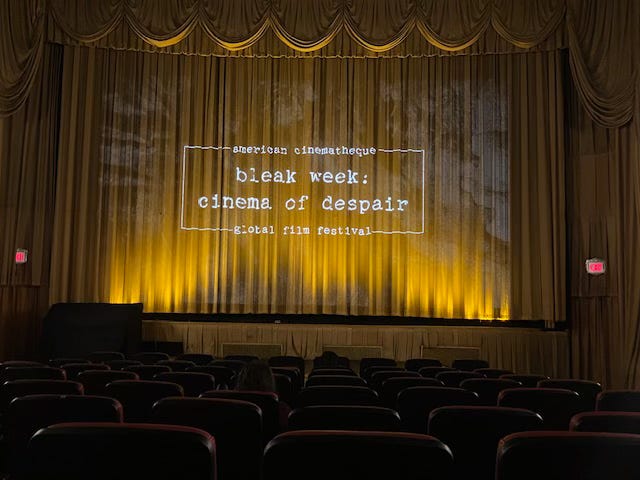
Perhaps that movie should have been one in the Bleak Week: Cinema of Despair series I went to though it wasn’t. (I saw Wages of Fear--bleak indeed--and the next night Treasure of Sierra Madre with Humphrey Bogart playing an utterly nasty guy.)
Of all the movies I saw, I seem to have been most moved by those that were Asian or made by Asian directors. After Life, is a Japanese movie from 1998, about people in a waiting station between this life and the next. I feel so lucky to have been able to see this one in the theater! The movie was crammed with so many images, textures, and themes I love--a neglected, cold old building, unexpected snowfall, unreliable storytelling that backtracks on itself, steaming tea, memory, ghosts, thoughts on life versus film, lots of atmospheric pausing. What if you have only one memory of this life to take with you to the next? What would the one memory be?
The beauty of these Asian films was in the layering of stirring details and the unusual way those images are delivered. For example, I love the way Wong Kar-Wai, the Chinese director, uses the camera sometimes like a voyeur, like an Edward Hopper painting, making you privy to what otherwise could be, or feels like, a private scene. I watched My Blueberry Nights (2007), which is the 4th or 5th Wong Kar-Wai movie I’ve seen, and I recognized once again his use of things he must love--trains clattering by, businesses at closing time, a solitary character by a window in the rain at night. I enjoy these details too, and love that I sometimes find his stories a little disjointed, uneven, untidy.
My favorite of the Asian films--of all the films--I saw this past month were Long Day’s Journey into Night (2018) which I saw at the theater, and its predecessor Kaili Blues (2015), which I watched later at home. Both are Chinese, directed by Bi Gan. Storytelling in these movies is woven, linear but not, like dreams, like memory. The imagery is visceral, the camera moving the viewer through a labyrinth so that we are always curious and nearly, but never quite entirely, lost.
I’m inspired by the complex work it takes to craft these stories. The filming and rewriting and reshooting and cutting again. As a writer, I find this particularly fascinating. The directors are working with images and plot and dialogue in a totally different way than a writer of a book. Certainly a film is more collaborative. Also, words on a page travel more slowly into the brain, so writers will never have the instantaneous effect of film. In these films, and others I love best, the audience is left to infer almost everything through images, and what is there to infer is highly ambiguous. However, for all the mountains of differences, filmmaking and novel writing can be somewhat the same.
So, my question (as always) becomes, as a writer, how can I use this?
One of the most obvious ways I can use what I have seen in these Asian films to enrich my writing is to examine the details that drew me in. Intense, scrappy, settings made unusual and compelling through detail and perspective. Compelling characters we want to know more about, so keep following, though some secrets are never fully revealed. A plot that suggests resolution, but never moves quite directly there, so, as an audience member we are never sure what the end will be, until we get there and feel, “Ah!”
When I look closely, I see that above all, what appeals to me is the repeated and intentional use of images of things I find captivating and which others must see that way as well. Images I mentioned before, like the rain on the cafe window at night behind which sits a solitary figure, a girl pinning up her hair and then pausing to study her face in a mirror, light from a neon sign across the street shining through a gauzy curtain or half pulled shade, a child in a mask emerging from a locked cabinet.
Of course, we see this with writers too, the terrain of the story, the texture, those images that keep us readers coming back. I will always want to be with Michael Cunningham’s characters in New York, for example. Some passages in Specimen Days left me breathless.
The idea is to open your subconscious and see, to move closer, to use specificity to build curiosity, amazement, and ultimately, pleasure.
Desk Set is a fave and a Christmas season go to.